
What is CATIA? Complete Guide to Features, Benefits, and Applications
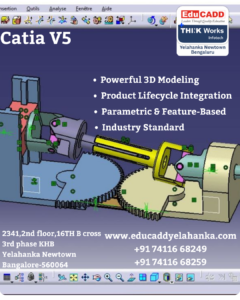
CATIA (Computer Aided Three-Dimensional Interactive Application) is a powerful computer-aided design (CAD) software developed by Dassault Systèmes, France. It is widely used in industries such as aerospace, automotive, shipbuilding, industrial equipment, and consumer goods for designing, simulating, and manufacturing complex products.
CATIA supports the entire product development lifecycle, from conceptual design and engineering to simulation, documentation, and manufacturing. Its advanced capabilities make it one of the most trusted tools for professional designers and engineers worldwide.CATIA
Key Features of CATIA
CATIA offers a wide range of tools that make it a complete product design and engineering solution:
🔹 3D Modeling
Solid modeling
Surface design
Wireframe and sketch-based modeling
Complex shape creation
🔹 Assembly Design
Manage large and complex assemblies
Product structure management
Configuration visualization
🔹 Simulation & Analysis
Finite Element Analysis (FEA)
Kinematics simulation
Thermal and structural analysis
🔹 Specialized Design Modules
Sheet metal design
Electrical systems design
Fluid systems design
Composite materials design
🔹 Technical Documentation
2D engineering drawings
Exploded views
Production-ready documentation
Why Should We Use CATIA?
CATIA is preferred by professionals due to the following reasons:
Comprehensive tool for design, simulation, and manufacturing
Easy integration with CAM, CAE, and PLM tools
Used across multiple industries
Reduces design errors and improves productivity
Supports collaborative engineering through cloud-based solutions
How Does CATIA Make Work Easier?
CATIA simplifies complex engineering tasks through:
User-friendly interface for smooth workflow
Advanced 3D modeling tools for precision design
Efficient assembly management for large projects
Built-in simulation tools to validate designs before manufacturing
Automation features like generative shape design and drafting
Real-time collaboration for team-based projects
These features help engineers save time, reduce errors, and improve overall efficiency.
What Can You Do with CATIA?
Using CATIA, you can:
Design complex 3D mechanical and industrial components
Assemble parts into a complete product
Perform design validation and simulations
Create detailed 2D drawings and documentation
Automate repetitive design tasks
Create product animations to visualize motion and performance
Collaborate with teams across locations
Working Process in CATIA
The typical CATIA workflow includes:
Modeling – Creating 3D components and assemblies
Simulation – Testing performance using analysis tools
Collaboration – Reviewing and modifying designs with teams
Documentation – Generating drawings and technical documents
Manufacturing Preparation – Tooling, fixtures, and production drawings
Automation tools help streamline each stage for faster development.
Benefits of CATIA
Advanced 3D modeling capabilities
Strong assembly and data management
Integrated simulation and validation
Efficient collaboration tools
Time-saving automation features
Seamless integration with other engineering software
Highly versatile across industries
Limitations of CATIA
Despite its strengths, CATIA has some limitations:
Complex learning curve for beginners
High software cost
Requires high-performance hardware
Uses proprietary file formats
Limited advanced 2D drafting tools
Some limitations for extremely large-scale models
Note: These limitations may vary based on CATIA version and modules.